Promotions and Activities


 Home
HomeT25 vs T75 vs T175 Cell Culture Flask: How to Choose the Right Size for Your Lab
 2026-06-25
 1
1
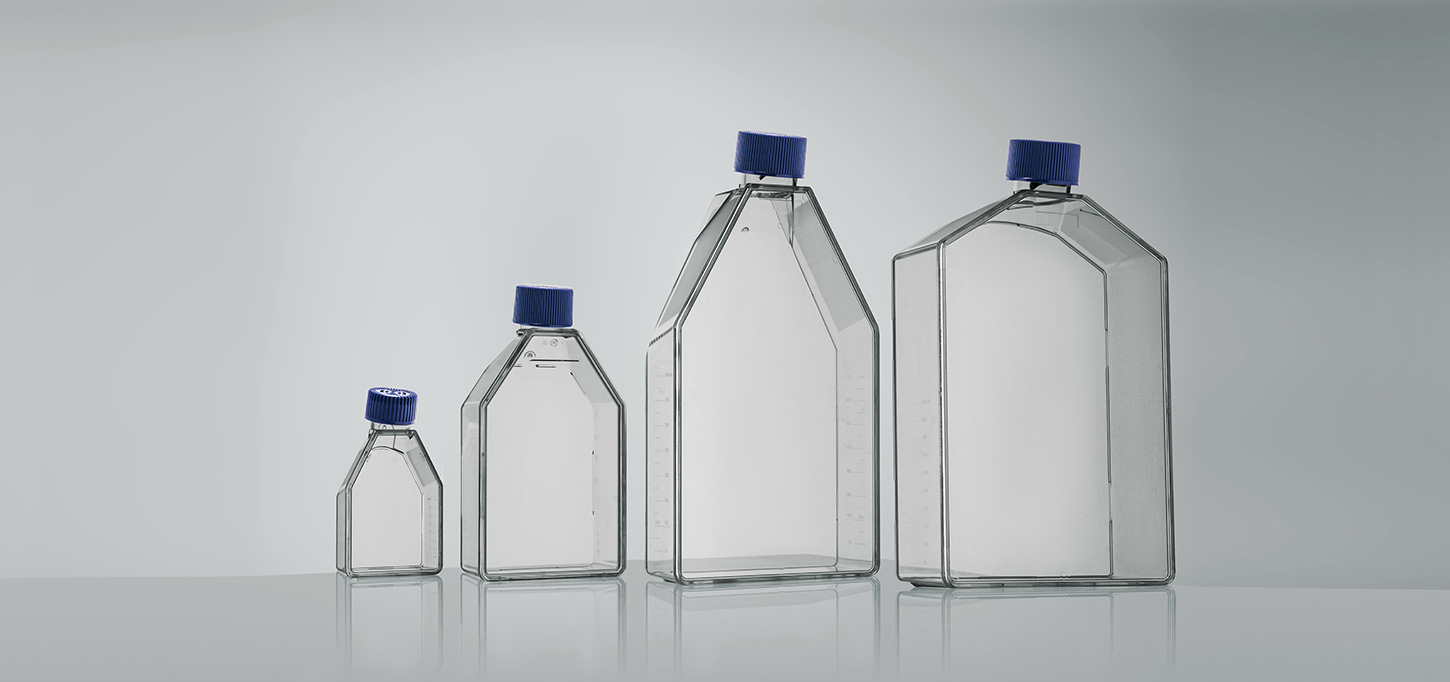
Choosing the right cell culture flask size is one of the most practical decisions you make in routine cell maintenance. The wrong choice does not necessarily ruin your experiment, but it wastes media, increases passage frequency, and creates unnecessary handling steps. This guide breaks down the differences between T25, T75, T175, and T225 flasks so you can match flask size to your actual experimental needs.
Why Flask Size Matters in Cell Culture
The number in a flask designation refers to its growth surface area in square centimeters. A T75 flask has 75 cm² of growth surface; a T175 has 175 cm². Surface area determines how many adherent cells you can culture at confluence before they need to be passaged.
More surface area means more cells per flask — but also more media volume, more reagents, and more handling per vessel. For high-throughput labs scaling production, larger flasks reduce the number of vessels to manage. For early-stage work or precious primary cells, a smaller flask gives you tighter control over your culture with less material committed per vessel.
Matching flask size to your cell density requirements and downstream applications is the baseline of efficient cell culture practice.
T25 Flask: Best for Primary Culture and Small-Scale Work
The T25 flask holds approximately 5–7 mL of media and supports cultures up to around 5–8 × 10⁶ cells at confluence, depending on cell type.
Best use cases:
● Initial establishment of primary cell cultures, where cell numbers are limited, and loss is costly
● Screening experiments requiring multiple conditions in parallel without large cell numbers
● Cryopreservation recovery and post-thaw expansion
● Teaching and training environments where media and reagent consumption should be minimized
● Low-passage-number banking of valuable cell lines
The T25 is a controlled environment for early-stage work. It is not the right choice once you need cells at scale — passaging from a T25 into another T25 repeatedly adds time without increasing your yield.
T75 Flask: The Standard for Routine Maintenance
The T75 is the most widely used flask size in research labs for good reason. It holds 15–20 mL of media and supports roughly 2–3 × 10⁷ cells at confluence. It is large enough to provide meaningful cell yields, small enough to handle comfortably, and fits standard incubator shelving without issue.
Best use cases:
● Routine maintenance and serial passaging of established cell lines
● Protein expression studies requiring moderate cell quantities
● Viral transduction and stable cell line generation
● Most transfection experiments
● General expansion ahead of downstream assays
For the majority of research applications, the T75 is where you will spend most of your time. A lab maintaining 3–5 cell lines will typically work almost entirely in T75 flasks, stepping up only when specific experiments demand higher cell numbers.
T175 and T225: Scaling Up for Production
T175 and T225 flasks are designed for situations where cell yield is the primary goal. The T175 holds 40–50 mL of media; the T225 holds up to 70 mL. At confluence, these flasks can yield 5–8 × 10⁷ cells or more depending on the line.
Best use cases:
● Biopharmaceutical manufacturing and recombinant protein production
● Large-scale viral vector production for gene therapy research
● Harvesting cells for proteomics, metabolomics, or ChIP-seq experiments with high input requirements
● Producing conditioned media at scale
● Bioprocess development upstream of bioreactor transition
One T175 replaces approximately two to three T75 flasks in terms of surface area, which means fewer vessels to open, fewer contamination events, and less time spent in the biosafety cabinet. For labs running large-scale production routinely, the reduction in handling is meaningful.
PakGent Bio's 225 cm² Cell Culture Flask is available with both plug-seal and vented cap options to accommodate a range of incubator configurations.
Vented Cap vs Plug-Seal Cap: Matching Your Incubator
Cap type is as important as flask size for CO₂-dependent cell lines.
Vented cap (filter cap): Features a 0.22 µm hydrophobic membrane that allows gas exchange between the flask interior and the incubator atmosphere. Required for cells cultured in CO₂ incubators, where bicarbonate buffering depends on CO₂ diffusing into the media. This is the standard choice for most mammalian cell lines.
Plug-seal cap: Creates a fully sealed environment. Used when CO₂ incubators are not available, or when flasks are being transported, shipped, or stored temporarily. Also appropriate for some suspension cultures using HEPES-buffered media that does not rely on CO₂ equilibration.
A common sourcing mistake is ordering plug-seal flasks for CO₂ incubator use. The result is pH drift in the media and compromised cell health. Always confirm cap type matches your incubator setup before placing a bulk order.
Adherent vs Suspension Cell Culture: Does Flask Choice Change?
For adherent cells, the growth surface treatment determines whether cells will attach and proliferate. Standard cell culture-treated flasks are surface-modified to promote attachment. This is appropriate for most established cell lines including HEK293, HeLa, CHO, Vero, and fibroblasts.
Suspension cells — including many hematopoietic lines, hybridomas, and insect cells — do not require surface attachment. For these applications, use flasks with a non-treated or ultra-low attachment surface, or switch to Erlenmeyer flasks designed for agitated suspension culture.
Putting suspension cells into a standard treated flask is not always catastrophic, but it creates unnecessary adhesion and clumping that affects growth kinetics. Putting adherent cells into a non-treated flask prevents attachment entirely. Matching surface treatment to cell type is not optional.
What to Ask Your Cell Culture Flask Manufacturer
When sourcing flasks for a lab or institution, the product specifications matter — but so does the supplier's manufacturing quality and flexibility. Key questions to ask:
Sterility assurance: What is the SAL (Sterility Assurance Level)? Look for SAL = 10⁻⁶ as the standard for research-grade consumables. Radiation sterilization is standard for disposable cell culture flasks.
Certifications: Are flasks certified DNase/RNase-free, endotoxin-free (pyrogen-free)? These certifications matter for sensitive cell lines and downstream molecular analysis.
Cap options: Are both vented and plug-seal caps available across all flask sizes? Can you mix cap types within an order?
Surface treatment options: Are both treated (adherent) and non-treated (suspension) surfaces available?
OEM capability: Can flasks be produced under your own branding? For distributors and institutions with private label requirements, this is an important supplier differentiator.
PakGent Cell Culture Flask Product Line
PakGent Bio manufactures cell culture flasks in T25, T75, T175, and T225 formats, available with vented or plug-seal caps and surface options for both adherent and suspension cell culture.
Key specifications across the product line:
● Material: High-clarity polystyrene
● Sterility: SAL = 10⁻⁶ (radiation sterilization)
● Certified DNase/RNase-free and pyrogen-free
● Angled, extra-wide neck for easy pipette and scraper access
● Molded graduations for convenient media measurement
● Raised cap edge for stable stacking
● OEM and custom branding available
| Flask | Growth Area | Recommended Media Volume | Cap Options |
| T25 | 25 cm² | 5–7.5 mL | Vented / Plug-seal |
| T75 | 75 cm² | 15–22.5 mL | Vented / Plug-seal |
| T175 | 175 cm² | 35–52.5 mL | Vented / Plug-seal |
| T225 | 225 cm² | 60–90 mL | Vented / Plug-seal |