Promotions and Activities


 Home
HomeWhen Should Laboratories Use Large-Volume Pipette Tips?
 2026-07-14
 1
1
Most labs default to standard 1000 µL tips and work around volume limitations when they arise. For transfers above 1 mL, this means multiple aspiration steps, increased handling time, and a higher risk of compounding errors with each additional pipetting action. Large-volume pipette tips — designed for 5 mL and 10 mL pipettes — eliminate this workaround.
Applications for 5 mL and 10 mL Pipetting
Large-volume tips are not a niche product. They cover a wide range of routine lab tasks that cannot be done accurately with standard tips:
1. Media and buffer transfers — dispensing cell culture media, PBS, or saline into flasks, dishes, and multi-well plates in volumes from 2 mL to 10 mL per well or vessel
2. Reagent preparation — transferring stock solutions, diluting concentrated reagents, or aliquoting master mixes at scale
3. Viscous liquid handling — glycerol solutions, serum, and other high-viscosity reagents that require wider bore geometry for accurate aspiration
4. Sample pooling — combining multiple sample volumes into a single tube without the error accumulation of repeated small-volume transfers
5. Bioreactor and fermentation work — adding supplements, pH adjusters, or inducers to culture vessels during active growth phases
6. Clinical and diagnostic sample processing — transferring larger specimen volumes in pathology and blood banking workflows
For any of these applications, performing the transfer in a single aspiration rather than multiple steps reduces both time and pipetting error.
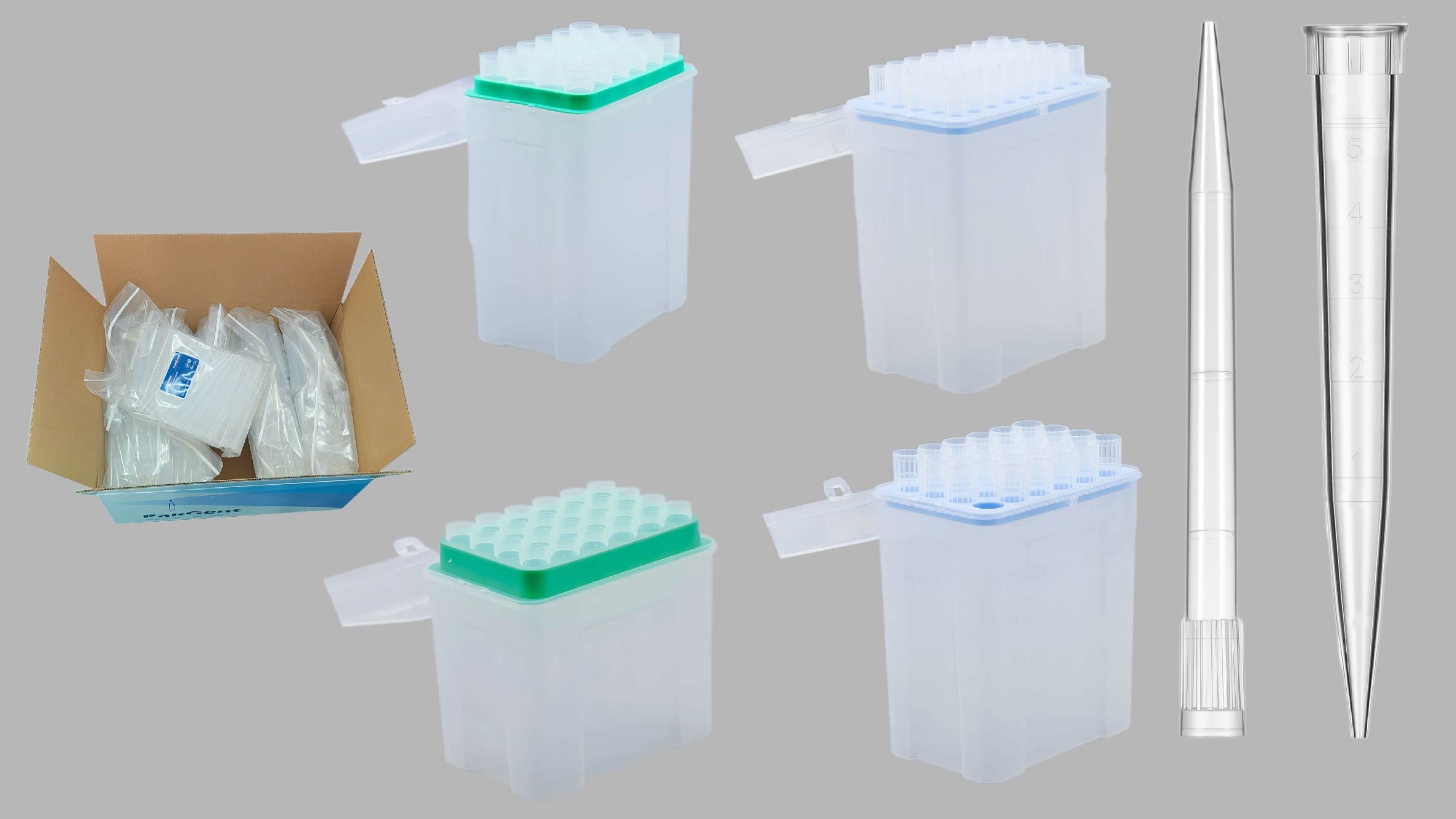
Benefits of Standard Tips
The practical advantages of large-volume tips over repeated standard tip transfers are straightforward:
Fewer steps, lower cumulative error. Every additional pipetting action introduces a small volume error. A single 5 mL transfer is more accurate than five sequential 1 mL transfers, where error compounds at each step.
Reduced contamination risk. Each pipette tip change is an opportunity for contamination. Minimizing the number of transfers directly reduces this risk, particularly in sterile cell culture environments.
Time efficiency at scale. In high-throughput labs dispensing media into 24-well or 96-well plates, large-volume tips significantly cut hands-on time per plate.
Wide-bore geometry for viscous samples. Standard tips create aspiration resistance with viscous liquids, affecting accuracy. Large-volume tips are designed with a wider bore that accommodates these samples without the pressure differential that causes volume error.
Compatibility with Major Pipettes
Large-volume tips are designed for use with 5 mL and 10 mL single-channel pipettes from major manufacturers. Confirmed compatibility includes instruments from Eppendorf, Thermo Fisher, Sartorius, and DLAB in the large-volume pipette category.
As with any tip format, compatibility depends on cone geometry matching the specific pipette shaft. Before ordering in bulk, verify compatibility by requesting samples and testing seal integrity at your standard working volumes. A tip that seats loosely on a specific pipette model will introduce the same volume error you are trying to eliminate.
Wide-bore tip design also matters for multichannel applications — confirm the tip geometry is appropriate for your instrument before committing to volume orders.
Accuracy Considerations
Large-volume pipetting introduces accuracy variables that do not exist at standard volumes:
Angle of aspiration. At 5–10 mL, even a slight tilt of the pipette during aspiration changes the immersion depth and can introduce air. Keep the pipette vertical or at a consistent shallow angle throughout the aspiration stroke.
Pre-wetting. For aqueous solutions, pre-wetting the tip interior (aspirating and dispensing once before the actual transfer) equilibrates the tip surface and improves volume accuracy, particularly for the first transfer from a new tip.
Surface tension effects. At larger volumes, the liquid meniscus inside the tip carries more mass. Allow a 1–2 second pause after aspiration to let the meniscus stabilize before withdrawing from the solution.
Tip quality. Wall thickness consistency and interior surface uniformity directly affect how liquid behaves inside the tip. Tips manufactured from virgin polypropylene with uniform wall geometry perform more predictably than lower-quality alternatives.
Sterility Requirements
For cell culture, media preparation, and clinical applications, sterility is non-negotiable. Large-volume tips for these workflows should be:
-Certified RNase-free, DNase-free, pyrogen-free
-Sterilized by radiation sterilization (SAL = 10⁻⁶)
-Individually racked for sterile, one-touch loading — Rack packaging maintains tip sterility until the moment of use
-Available in Refill format for reloading existing racks economically in high-consumption environments
For non-sterile applications — general reagent transfers, buffer preparation, non-biological chemistry — Bulk packaging offers a more cost-effective option with no compromise on material quality.
Choosing Reliable Suppliers
Large-volume tips are a lower-volume SKU than standard 1000 µL tips, which means fewer manufacturers maintain consistent production and stock. When evaluating suppliers, prioritize:
1. Material certification — virgin polypropylene only, certified free of recycled content
2. ISO 13485:2016 manufacturing — indicates a quality management system built for medical-grade consumables
3. Dimensional documentation — cone geometry specs and seal integrity test data should be available on request
4. OEM capability — for distributors or institutions requiring private-label packaging
5. Packaging flexibility — Rack and Bulk options across the same product line
PakGent Bio manufactures large-volume pipette tips in 5 mL and 10 mL formats, certified RNase/DNase-free and produced under ISO Class 8 cleanroom conditions, available in Rack, Refill, and Bulk packaging.